

Walking Forward Backwards
The Myth of the Paved Road


Finding our way — finding a way, any way— is not quite the forward-facing endeavor we are often led to believe it is. We tend to think of “finding our path” as if we are scouting a route to some point ahead of us on the horizon. As if we know where we are going, and all we need to do now is to figure out the correct, fastest, or easiest path to reach our destination. This, however, is little more than wishful thinking.
If you pause and honestly look at your own life, does it resemble anything like a paved trail? Is it leading towards the destination you once imagined? Or does it feel suspiciously more like somewhere along the way you’ve been kidnapped by a gang of overenthusiastic life-coaches, bundled into a sack and whisked off only to be deposited, blindfolded, in the middle of the jungle on a remote island at the stroke of midnight? Perhaps you even recall once having an ambitious plan, possibly involving spreadsheets, or at least a To-Do list, but where it went is anybody’s guess.
Finding our path is a rarely a direct act. As the saying goes, life is what happens while you’re busy making other plans, and it is only when we stop making those plans that we finally see the life that has been happening all along.
The path forward is not some clear, well-marked road awaiting our confident strides. We are more like someone walking backwards—able to see the ground only as it appears beneath our feet with each step and turn, or, at times, as it crashes into us like a speeding truck at 100 miles an hour.
In a world obsessed with “visionary” thinking, this sounds like a recipe for disaster. But there is a profound, grounding relief in this reversal. When we finally admit we are walking backwards, the crushing pressure to “know where we are going” simply evaporates.
Reversal of the Dao
To find our feet in this jungle, we might look to a tradition that has spent millennia studying the way of the world—not as a highway built with blueprints, but as the underlying flow of reality itself. In Chinese thought, this underlying flow is called the Dao—the way or course of things. It is explored most deeply in Daoism, and most famously articulated in the Daodejing. Because Classical Chinese does not distinguish between the way, a way, or ways, the Daodejing becomes less of a map and more of an apprenticeship in waymaking. It suggests a nameless, uncarved pattern of how things actually happen when we stop trying to fit them into our own expectations and designs. It is the way of water, the way of the seasons, the way of the wood’s growing grain.
In a passage which pithily summarizes one of the most fundamental principles of Daoist thought, the Daodejing (often known as Tao Te Ching) states:
“Turning back (/reversal) is how the Dao moves” (DDJ 40)
We’re often taught to move forward with unwavering certainty and purpose, to overcome obstructions by pushing ever higher, harder. Yet reality often pushes back, or simply laughs in our face. The Daodejing suggests that movement is never a straight line toward a fixed destination. Rather, the pattern of reality is one of ebb and flow, of growth and decay, of constant movement and counter-movement.
In our modern “religion of progress,” this observation is outright blasphemous. We are obsessed with efficiency, quantifying our existence into a series of milestones and metrics. For me, this isn’t an abstract critique; having spent over a decade as a programmer, I have lived within the machinery of this obsession—the relentless drive to optimize workflows and measure the value of a day by the sheer volume of its "output". We ask ourselves: Am I achieving enough? Am I successful enough? Am I moving ever faster, farther?
This view, however, is based on a fundamental mistake: we confuse what is efficient with what is better.
Our modern devotion to technological advancement echoes this confusion, promising ever-better “standards of living”—a dubious concept in itself, as if having higher standards is something to aspire to. Granted, technological advances can make some tasks easier, or production more efficient, but that is more accurately described as a rise in efficiency, not necessarily “progress” in the sense of the betterment of our lives or of the world around us.
If we develop technologies which allow us to get from one place to another more easily and speedily, is that necessarily a good thing? Hardly. On that logic, we may offer a cyanide pill to whoever wishes to arrive most speedily and easily to their final destination. I doubt many would accept.
Space and Place
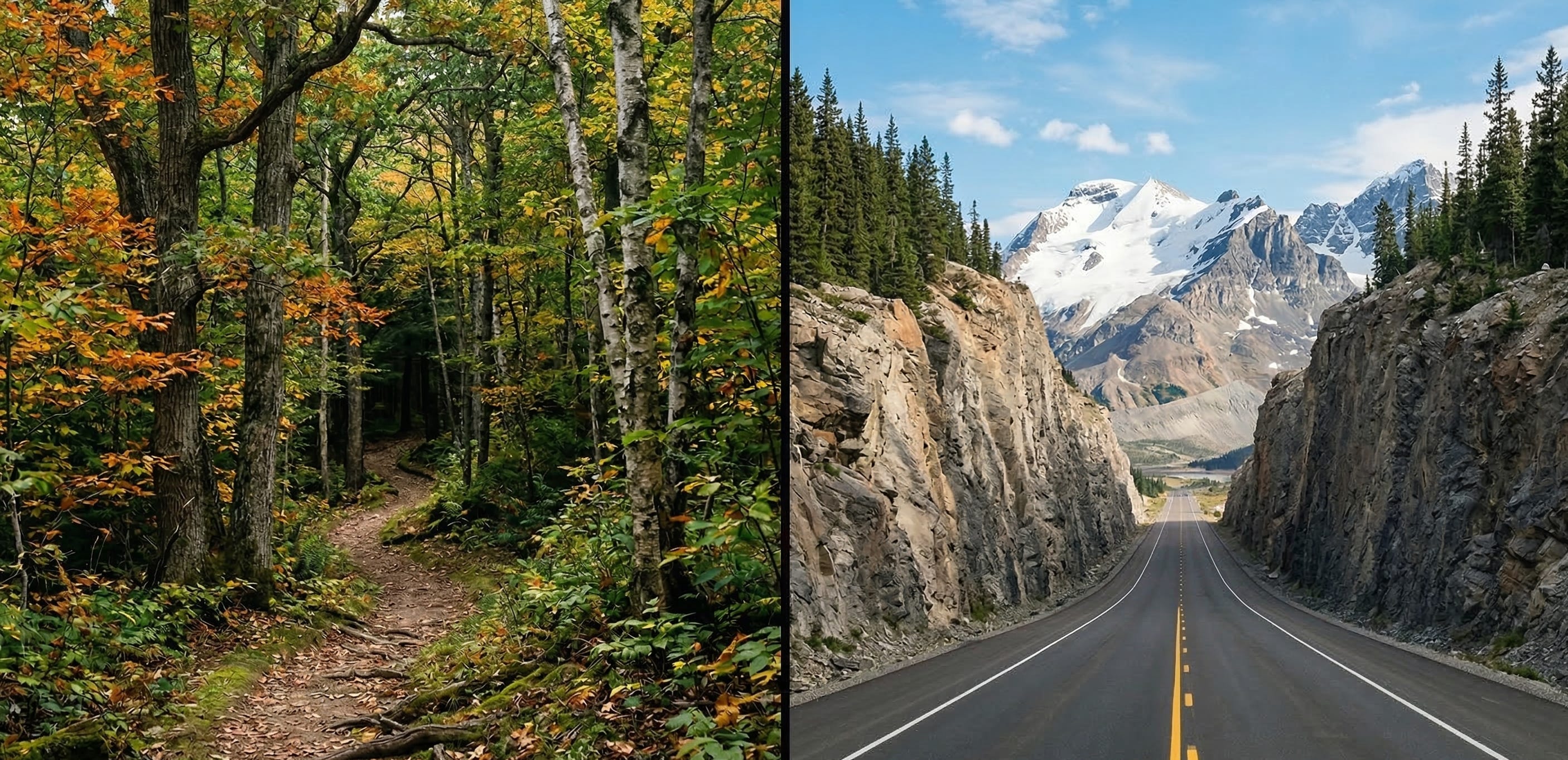
The American poet and philosopher Wendell Berry offers a helpful distinction here - between a path and a road.
A road, Berry says,
“embodies a resistance against the landscape. Its reason is not simply the necessity for movement, but haste. Its wish is to avoid contact with the landscape… its aspiration, as we see clearly in the example of our modern freeways, is to be a bridge; its tendency is to translate place into space in order to traverse it with the least effort. It is destructive, seeking to remove or destroy all obstacles in its way.”
A path, on the other hand, Berry calls a “ritual of familiarity”:
“A path is little more than a habit that comes with knowledge of a place... It is the perfect adaptation, through experience and familiarity, of movement to place; it obeys the natural contours; such obstacles as it meets it goes around.”
When we try to “plan” our lives forward, we are trying to build a road. We want a straight, efficient line into the future, one which bypasses the jungle, the chaos, the obstructions. But life doesn’t allow for roads; it only allows for paths.
Finding Our Way
We do not find our way by fixing our gaze on a prized destination, somewhere in the future. It is not “out there” ahead of us, waiting to be discovered. It is forged by our very movement itself. We can only ever see it in retrospect.
By looking back, the shape of our journey emerges, but we are never granted the power to glimpse whither we are going. At best, we can strive to understand where, among what, and with whom do we currently find ourselves.
We find it by bearing witness to the footprints we have already left.
Life is a journey indeed, and like any journey, it would be both dangerous and foolish to mistake arriving at the final destination with the purpose of the journey. The destination is an excuse—perhaps even a necessary one to get us moving at all—but an excuse nonetheless. This realization invites us to move our gaze from an imagined horizon and to inhabit the trail beneath our feet—not as a bridge to an elsewhere, but as the actual ground of our lives.