

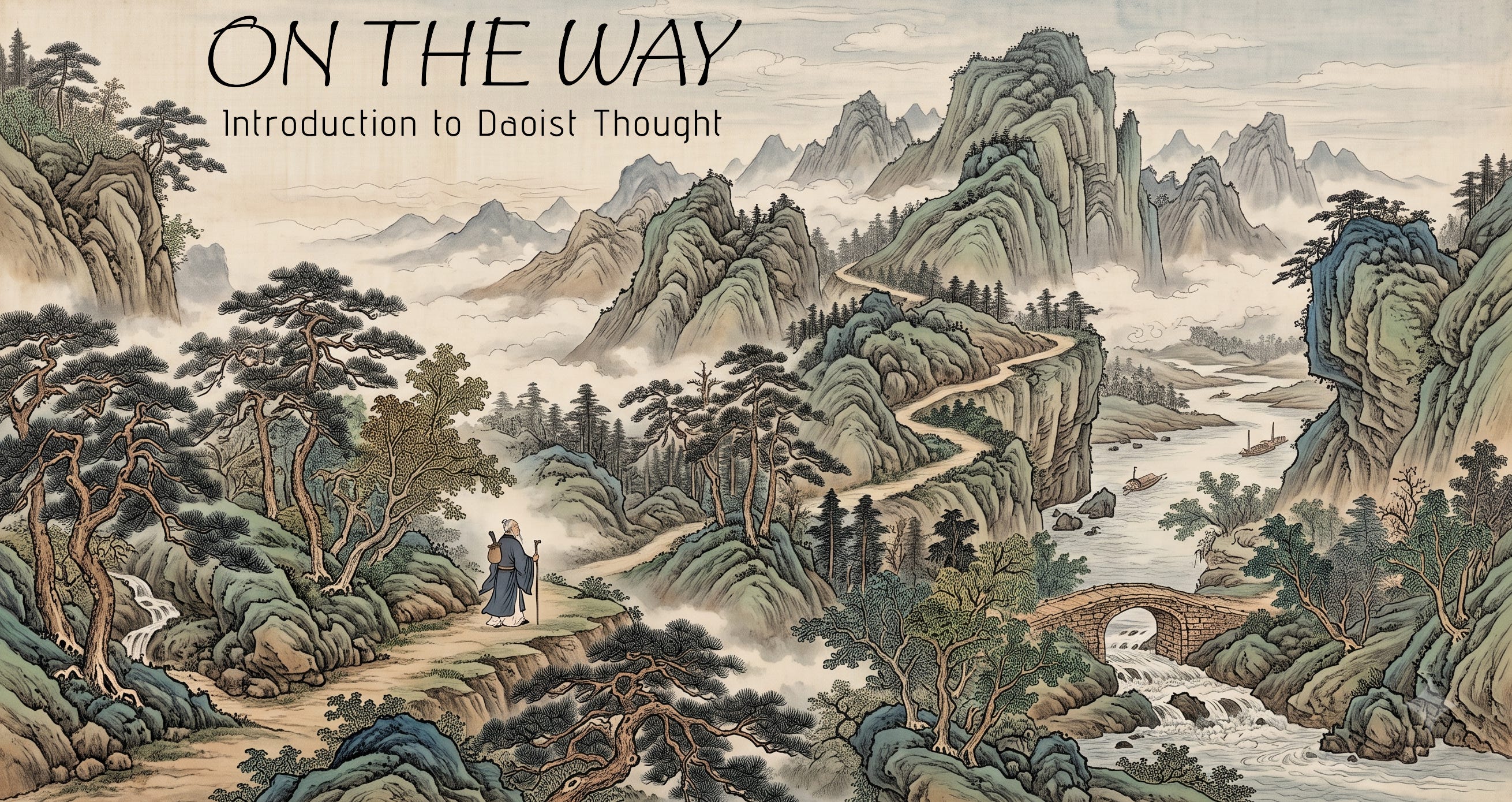
On the Way: An Introduction to Daoist Thought

We are living in a world that seems to be coming apart at the seams. Political fragmentation is on the rise while trust in institutions steadily erodes, ecological disruption arrives on our doorsteps in record-breaking heatwaves, floods, and storms, and economies statistically expand while the tangible opportunities of ordinary lives constrict more and more.
Private life itself is fracturing as relationships thin into text messages and mutual staring into screens. Our attention is overtaxed, fragmented into the constant surveillance of ourselves and one another, encouraging us to be anywhere but where we actually are. We possess more information than any civilization before us, but we are drowning in it. Our world is unraveling, and we grasp for something, anything, to keep ourselves afloat.
Our culture’s default reaction to this uncertainty is to prescribe the modern opium of the masses: optimization, efficiency, and the illusion of control. From the moment we wake and open our screens, our attention is kidnapped to serve in a relentless race to hit targets, achieve milestones, and master our environment, outsourcing our orientation to an endless cacophony of self-appointed guides.
When we realize our existing maps are out of touch with the terrain, our instinct is to run faster, clutch tighter to our metrics, and push harder in an attempt to force the world to conform to our designs. But what if this frantic pursuit of control is the very thing leaving us in a state of anxious isolation? If we cannot optimize our way out of confusion, how then do we find a path forward? How do we orient our lives when the structures once meant to do so—political, communal, personal—are themselves unraveling?
An Apprenticeship in Waymaking
We are not the first to face such challenges or to live through a time of great upheaval. I believe that to approach the pervasive uncertainty of our current condition, we can learn much from thinkers who didn’t merely tolerate ambiguity, but treated it as the very starting point of wisdom.
I want to invite you to a new series of explorations introducing Daoist (aka Taoist) thought, focusing particularly on the classic texts of the Daodejing (frequently spelled Tao Te Ching) and the Zhuangzi.1 The thinkers and textual traditions we now gather under the name “Daoism” emerged from a world in tumult. The sages who shaped this philosophy were living through an era of profound social, cultural, and political collapse known as the Warring States period, and the questions they were asking twenty-five hundred years ago are just as relevant today: How do we inhabit a fractured world without breaking? How do we find a sense of home when our external structures crumble?
The Daoist answer is a radical invitation: to trade the myth of mastery for a more humble outlook. It asks us to explore what it means to be part and parcel of our environment — to stand in the very midst of the world rather than lording over it, trying to control and “optimize” it. Importantly, what Daoism offers is a way of life, a practice coming alive not as an intellectual exercise for an ivory tower, but deeply embedded within our daily lives.
This is where this ancient philosophy offers a radical, liberating departure from the habits of mind we inherit in the modern West. It invites us to step out of our conceptual cage and look at reality through an entirely different lens. In early Daoist thought we discover an alternative to our most basic cultural conditioning:
Wholeness of being: Mind and body are not separate entities at war with one another, but a single, integrated existence in which thought, sensation, and emotion flow together.
Gentleness over strength: In our culture, softness is mistaken for weakness, but the rigid and brittle are often the first to fracture under pressure. Like water, real power lies in remaining supple and receptive, yet gradually subverting and wearing down the most rigid and unyielding structures.
Presence instead of excavation: Human growth is not a journey inward to discover a hidden, fixed “authentic self,” but a turning outward. It is an act of perceiving our surroundings, paying attention to our environment, and cultivating daily habits that allow new possibilities to emerge.
Unscripted flourishing: A well-lived life is not the architectural product of rigid blueprinting and strict milestones, but the cultivation of a capacity—the fluid ability to respond to the small, unpredictable events of the everyday.
Ultimately, Daoist thought is not an abstract metaphysical system, but a pathway rooted in the day-to-day thickness of our lived experience. This series is an invitation to harken—to stretch our attention toward something older, slower, and deeper.
In the coming essays, we will travel back into the world from which these texts emerged: first into the landscape and political order that shaped early Chinese civilization, and then into the centuries of fracture, argument, and transformation out of which Daoist thought arose.
I look forward to exploring this path with you.
A brief note on language: while older Western translations used the Wade-Giles spelling Tao, modern translations use the Pinyin spelling Dao, which more accurately captures the phonetic “D” sound of the original Chinese.